
The finance ministry has initiated an internal survey of the faceless regime to examine its effectiveness.
The faceless authority has suggested a host of changes in the assessment process following conflicts and practical difficulties raised by taxpayers since the new regime was introduced. On August 3, the National Faceless Assessment Centre issued a set of standard operating procedures (SOPs) to address several anomalies in the regime. The faceless centre, constituted by the Central Board of Direct Taxes, is the nodal authority and works as an interface for the faceless regime.
Though the system is called faceless, it would have a room for inviting tax payers through video conferencing.
This Budget positions India's taxation ideology as not merely a revenue source but as a strategic catalyst for growth, inclusion and long-term confidence.
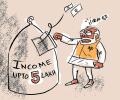
Any additions in demand made by a tax officer under the faceless assessment process for over Rs 5 lakh of income will undergo a rigorous review process before a final demand order is passed.
The new scheme came into effect on Thursday. However, even after a scrutiny assessment, appeals will continue to be done through personal representation.

The Federation of Indian Chambers of Commerce and Industry (Ficci) has sought urgent steps to clear the huge backlog of income-tax appeals, simplify tax deducted at source (TDS) compliance, and ensure tax neutrality for fast-track demergers, during its consultation with Revenue Secretary Arvind Shrivastava ahead of the Union Budget 2026-27.

'File all the supporting documents in response to the allegation since there is a possibility of the proceedings getting dropped at that stage if the reply is satisfactory.'
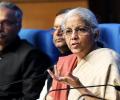
The eighth Budget of Finance Minister Nirmala Sitharaman continued to focus on 'GYAN' (Garib, Youth, Annadata, Nari) to maintain a consistent and coherent strategy initiated over the years in pursuing the government's vision for Viksit Bharat. The approach, characterised by incremental yet impactful steps, aims to create a compounding effect over time.

'Tax officials view most taxpayers as evaders.' 'The I-T department has a perverse incentive to raise unreasonable demands since the one-fifth tax collected counts towards officials' collection targets,' observes Harsh Roongta.

India's tax pie seems to have undergone a subtle change with a sharp drop in direct tax collections resulting from a disproportionate impact of the COVID-19 carnage on incomes. The share of indirect taxes, which mainly comprise of levy on goods and services as well as import duty, has risen while that of direct taxes - made up of corporate and personal income tax - has gone down in 2020. In an interview with PTI, finance secretary Ajay Bhushan Pandey said in a pandemic like this where the economy has been impacted, any large scale changes impact direct taxes more severely, whereas indirect tax collection is mostly proportional to business turnover and compliance.

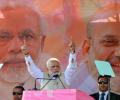
Addressing Bharatiya Janata Party leaders and workers on the birth anniversary of party's ideologue Deendayal Upadhyay, Modi asked them to reach out to farmers on the ground and inform them about details and benefits of the new agriculture reforms and how these will empower them.

Some of the policy measures announced are expected to go a long way in removing current challenges on financing faced by businesses and also increasing economic activity, especially in areas of construction and manufacturing.

'Wherever in the world there is political instability, those countries are beset with severe crises today. But India is in a much better position than the rest of the world due to the decisions taken by my government in the national interest,' President Droupadi Murmu said in her address to both Houses of Parliament.
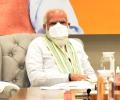
'I would like to convey the message to your readers that the prime minister himself is directly seized of the situation on the ground. He periodically reviews the situation on the ground and how it is moving forward, taking inputs from economists, business leaders, chambers of commerce.'

Of the seven surveys presented under Modi govt, predictions of three were quite close to the actual GDP growth rate, one saw the base year change in between, but the last three were way off the mark.
Even if the same party returns to power, what is important to debate is that having introduced an entitlement, how challenging it is to reverse such decisions, says Mukesh Butani.

Here's the full text of President Ram Nath Kovind's customary address to the joining sitting of Parliament on the first day of the budget session.
 © 2026 Rediff.com - Advertise with us - Disclaimer - Privacy Policy - Sitemap - Feedback - About us - Terms of use - Grievances